

The Love in Practice Framework.
Read about each dimension below, and move its slider to rate your current wellbeing in that area, from 1 to 10.
[Your personalised scores will be displayed at the bottom of the page.]
Return to the area that would welcome more care and attention in your life.
Click on the leaf icon to explore the relevant habits associated with that area of wellbeing.
[Your lowest score is a useful starting point; if scores are tied, choose the area that feels most important right now.]
The 8 Dimensions of Wellbeing
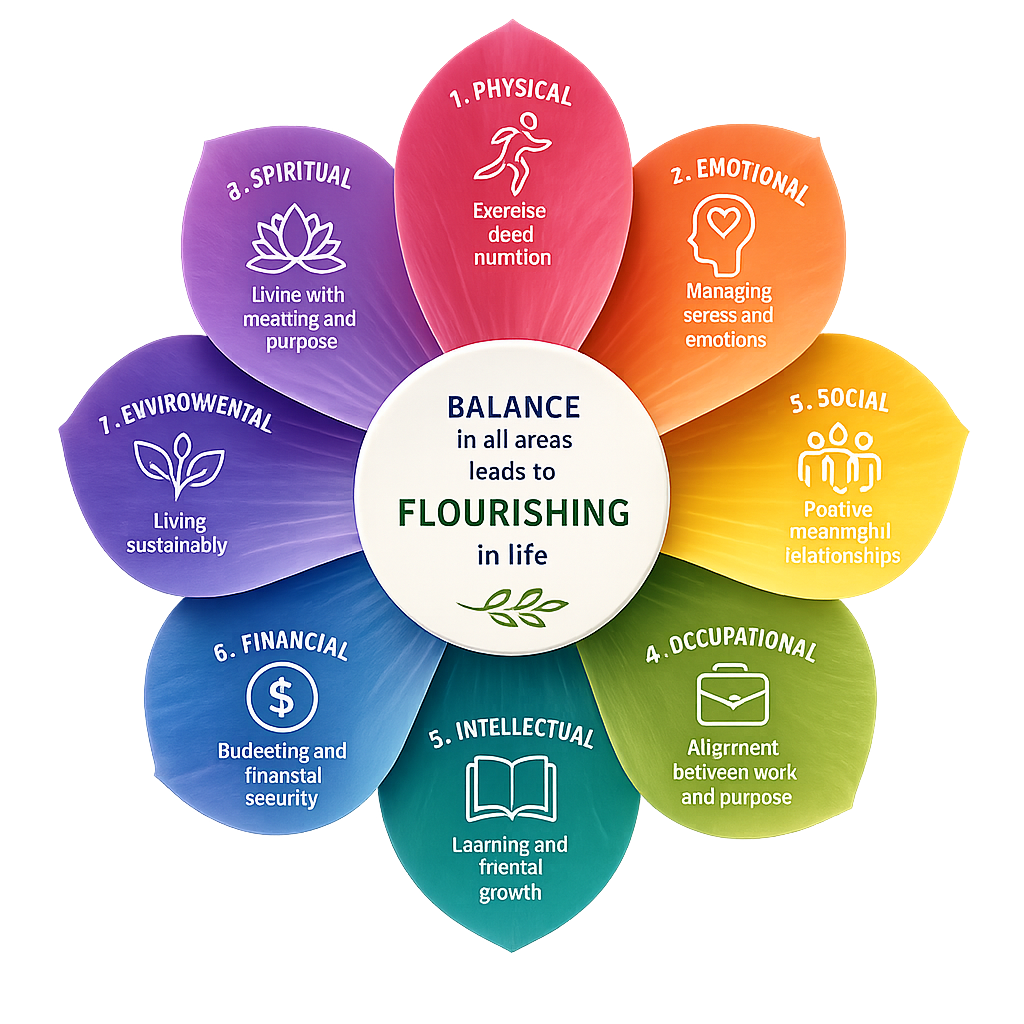
There are 8 areas we want to keep in balance to flourish in life:
Physical: Exercise, sleep, nutrition.
Emotional: Managing stress and emotions.
Social: Positive, meaningful relationships.
Occupational: Alignment between work and purpose.
Intellectual: Learning and mental growth.
Financial: Budgeting and financial security.
Environmental: Living sustainably.
Spiritual: Living with meaning and purpose.
As you go through the 8 dimensions, assess yourself on a scale from 1 - 10, with 1 being low in that dimension (this area requires my attention) and 10 being, “Yes, I’ve totally got this!”
Once you have identified your lowest score (the area that would welcome care) click on the leaf icon (of that dimension), and it will take you to the habits associated with that area of wellbeing.
Physical:
Exercise, sleep and nutrition.
Taking care of our bodies is essential for our overall happiness and wellbeing. Sleep, nutrition, and exercise create a synergy that supports our journey towards holistic health and enduring happiness. Integrating small acts of self-care into our daily routine, be it through nurturing nutrition, rejuvenated rest, or joyful movement, paves the way for a life marked by a deeper sense of contentment and vitality. It invites us to consider how our daily choices contribute to our long-term happiness.
Embracing this approach, we align with Aristotle's ethos, building a foundation of excellence not just in pursuits outside ourselves, but more importantly, in the care and appreciation of our body and mind. Our goal is to create a sustainable lifestyle where excellence in wellbeing becomes a habit, deeply woven into the fabric of our everyday lives
Sleep:
People often think, if I make more money, I’ll be happier. If I get a new job, I'll be happier. If I’m married, I’ll be happier, or if I get divorced I’ll be happier! But, in fact, the quality of the sleep you get each night is more important than any of these. The rhythm of sleep, aligned with nature's cadence, encourages a restorative process, vital for our body's ability to rejuvenate and thrive.
Nutrition:
Our dietary choices have the power to either bolster or deplete our happiness chemicals. Eating food that is fresh, drinking plenty of water, and preparing our food with love gives our bodies the true nourishment they deserve.
Exercise:
Our intuition improves when we become grounded and one of the best ways to stay grounded is through exercise. When we exercise our bodies are connected to the earth. Physical activity not only strengthens our body but also stabilises our mood and reduces stress. Finding a form of exercise we genuinely enjoy ensures consistency and transforms this aspect of self-care into a source of joy rather than a chore.

Emotional:
Managing stress and emotions
The biggest robber of happiness is stress. As long as we’re alive, we all have stress. The problem is not that we have stress, but the way we deal with it (how long we stay in a stressful response), and how quickly we recover from it. One way to help our bodies to manage our emotions is to give ourselves permission to feel our feelings.
How are you relating to your feelings? Reflect on your ability to notice emotions, respond with care and find support when life feels difficult.
One of the greatest barriers to love is the habit of avoiding emotional pain and negative feelings. We have a deep-seated fear of being overwhelmed by them and do our best not to feel them. The purpose of feeling our feelings is not to get rid of them, but to let them fulfill their purpose—which is bringing our awareness to the things in our lives that need our attention. How easily do you pay attention to why you are feeling frustrated or sad or angry? How aware are you of what is going on that may be causing these emotions?
Social:
Positive, meaningful relationships
Whether it's the relationship with ourselves or with others, the connections we build can have a profound impact on our overall wellbeing. How connected and supported do you feel? Reflect on the relationships in which you give and receive care, feel you belong and can be yourself. Emotions are contagious. Just as laughter spreads, so do stress and negativity. The people you spend time with influence your mood, energy, and outlook on life. Surrounding yourself with positive, encouraging people can lift your spirits and strengthen your wellbeing, while constant negativity can drain it. Relationships that are supportive, honest, and aligned with our values help us grow and thrive. Meaningful communication—where we feel safe to be open, heard, and kind—deepens connection and strengthens wellbeing. What are the quality of your relationships? Can you notice which ones nurture you and which ones may need care?
The Relationship with Yourself
The relationship you have with yourself shapes every other relationship in your life. When you practice self-care, self-respect, and compassion, you create a strong foundation for healthy connections with others. Knowing your worth, listening to your needs, and setting healthy boundaries helps you choose relationships that feel supportive, respectful, and aligned. When you value yourself, you show up with greater confidence and invite deeper, more nourishing connections.
Healthy Boundaries
Healthy boundaries protect your energy and support respectful relationships. Boundaries help you honour your needs, communicate clearly, and make choices that support your wellbeing. They also build emotional resilience, allowing you to step back from draining or unhealthy connections and invest more fully in relationships that inspire, support, and uplift you.
Occupational:
Alignment between work and purpose
Occupational wellbeing is not only about what we do for work, but how connected we feel to what we do each day. Research and lived experience show that many people move through life feeling uninspired or disconnected from their work.
Howard Thurman captured this beautifully when he said:
“Don’t ask what the world needs. Ask what makes you come alive and go and do it, because what the world needs is people who have come alive.”
Occupational alignment begins by noticing what makes you feel most alive. What expands you? What sparks curiosity, meaning, or joy? What activities leave you feeling energised rather than depleted? When your work—paid or unpaid—includes elements of what you care deeply about, it becomes an expression of your authentic self.
Clarity about purpose rarely arrives through waiting or overthinking. It comes through action. Each time you choose work, tasks, or contributions that matter to you, your sense of direction strengthens. Over time, these choices shape a work life that feels more meaningful and aligned.
Many traditions refer to this as dharma—“that which upholds.” When you are living your dharma, you are using your natural gifts in service of something greater. This might look like creating beauty, supporting others, building systems, teaching, healing, or bringing care and presence into everyday tasks. Purpose is not something you retire from; it is something you express through who you are.
Occupational wellbeing grows when work reflects our values, honours our strengths, and allows us to contribute in ways that feel meaningful. When work and purpose align, motivation increases, energy rises, and a deeper sense of fulfilment naturally follows. How meaningful and sustainable does your work or daily contribution feel? Include paid work, study, caring, volunteering or other purposeful activity.

Intellectual wellbeing includes how we think, learn, and relate to our own minds. Our internal dialogue—often called self-talk—runs constantly in the background of our lives and has a powerful impact on our mental health and self-esteem. Research suggests we have tens of thousands of thoughts each day, and many of them are repeated patterns. Without awareness, our minds can easily replay worries, self-criticism, and negative assumptions, leaving us feeling mentally drained.
Learning to care for our mental health starts with a simple but powerful insight: we do not have to believe everything we think. We can choose which thoughts we give our attention to. By developing awareness of our thoughts and intentionally focusing on learning, growth, and possibility, we strengthen our intellectual wellbeing. Over time, this shift helps us build a kinder inner voice, greater emotional balance, and a more hopeful and empowered relationship with our own mind.
How engaged is your mind? Reflect on curiosity, learning, openness to new perspectives and the way you relate to your thoughts.
Intellectual:
Learning and mental stimulation

Financial
Financial wellbeing is not about how much money we have; it is about how safe, supported, and in control we feel in relation to money. When our basic financial needs are met and we have a sense of stability, our minds are freer to focus on learning, relationships, creativity, and growth. Ongoing financial stress, on the other hand, can affect our mental health, sleep, confidence, and sense of security. Financial security supports peace of mind, strengthens resilience during challenges, and allows us to make choices that align with our values and goals. By developing financial awareness and seeking support when needed, we take an important step toward greater stability, confidence, and overall wellbeing.
How secure and supported do you feel in relation to money? Reflect on your current circumstances, access to resources and ability to manage financial demands.
Environmental:
Living sustainably
Environmental wellbeing recognises that our health and happiness are deeply connected to the world around us. We do not live in isolation—we are part of a larger living system that includes nature, community, and future generations. When we care for our environment, we are also caring for ourselves.
Living sustainably means making choices that respect and protect the natural world, so it can continue to support life. Clean air, fresh water, healthy soil, and green spaces are essential for physical health, mental clarity, and emotional balance. Spending time in nature has been shown to reduce stress, improve mood, and increase feelings of calm and connection.
By living more sustainably, we develop awareness of how our choices affect the world around us. This awareness encourages mindfulness, gratitude, and respect for life. Environmental wellbeing supports a balanced, meaningful life by reconnecting us to nature, to community, and to the understanding that our wellbeing is woven into the wellbeing of the planet itself.
How does your environment support you? Reflect on your surroundings, access to nature and your relationship with the wider living world.
Spiritual:
Living with meaning and purpose
Spiritual wellbeing is about feeling connected to something greater than yourself—whether you call it life, nature, love, source, spirit, or the universe. It invites us to explore meaning, purpose, and our place within the wider web of existence. When spiritual wellbeing is nurtured, we often experience greater peace, trust, and a sense of being supported by life itself. Spiritual wellbeing is strengthened through practices that help us slow down and listen inwardly. Meditation, prayer, time in nature, and moments of silence allow us to step out of constant doing and reconnect with presence. These practices help calm the nervous system, reduce stress, and create space for insight, clarity, and inner guidance. Research shows that regular contemplative practices support mental, emotional, and physical health.
When we feel disconnected from spiritual meaning, life can begin to feel repetitive or empty—focused only on routine and survival. Reconnecting with our inner world helps restore a sense of purpose and wholeness. By making time to “plug in” to presence each day, we nourish the part of us that longs for peace, belonging, and love.
What helps you feel connected to meaning and something beyond yourself? This may include faith, contemplation, nature, values or a sense of shared humanity.
Your Wellbeing Scores
Your wellbeing scores
See your ratings together below. Notice which area you would like to give some care and attention.
Your scores are a reflection of how you feel right now. There are no right or wrong answers.